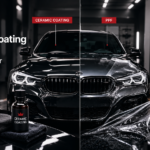
Your car’s paint faces a lot more than dust and dirt. Everyday driving exposes it to road debris, small stones, bird droppings, tree sap, harsh sunlight, and other elements that can affect its appearance over time. If you want to keep your vehicle looking its best, investing in paint protection is worth considering.
Two popular options are ceramic coating and paint protection film, also known as PPF. Both help protect your vehicle, but they work in different ways and are designed to address different concerns.
So, which is better for your car? The answer depends on how you drive, where you park, how much protection you need, and what you want to spend.
In this guide, we will explain the differences between ceramic coating and PPF so you can make the right choice for your vehicle.
Ceramic coating is a liquid protective product applied to a vehicle’s painted surfaces. Once properly applied and cured, it forms a durable, bonded layer that helps protect the paint from certain environmental contaminants.
One of the biggest reasons car owners choose ceramic coating is its glossy finish. It enhances the appearance of the paint and makes the surface easier to clean.
1. Enhances gloss and shine
Ceramic coating can give your vehicle a rich, glossy appearance. It helps bring out the depth of the paint, making the finish look cleaner and more refined.
2. Makes cleaning easier
The coating creates a hydrophobic surface that encourages water to bead and roll off. Dirt and grime can be easier to remove during regular washing, although the vehicle will still need proper maintenance.
3. Helps protect against environmental contaminants
Ceramic coating can make the paint more resistant to certain contaminants, including bird droppings, tree sap, and road grime. However, contaminants should still be removed promptly to reduce the risk of staining or etching.
4. Supports long-term paint maintenance
With proper preparation and care, a quality ceramic coating can help maintain your vehicle’s appearance for an extended period. Its lifespan depends on the product, application quality, driving conditions, and maintenance routine.
Ceramic coating is not a physical shield against road debris. It does not reliably prevent rock chips, deep scratches, or damage caused by impacts.
If your main concern is protecting the front of your vehicle from stones and road debris, paint protection film may be the better option.
Paint protection film, commonly called PPF, is a transparent film installed over painted surfaces to help protect them from physical damage.
Unlike ceramic coating, which provides a thin protective layer, PPF creates a physical barrier between your car’s paint and the outside environment.
It is especially useful for vehicles that are regularly driven on highways, exposed to road debris, or parked in areas where minor impacts and scratches are more likely.
1. Helps prevent rock chips
One of the main advantages of PPF is its ability to absorb and reduce the impact of small stones and road debris. This makes it particularly useful on the front bumper, hood, fenders, and side mirrors.
2. Protects against minor scratches
Depending on the film, PPF can help reduce damage from light abrasions and everyday contact. Some modern films also have self-healing properties that allow certain light surface marks to disappear with suitable heat.
3. Preserves the original paint
By protecting the paint from many common forms of physical damage, PPF can help maintain your vehicle’s original finish. This may also be beneficial if you plan to keep the car for several years or want to preserve its appearance for resale.
4. Offers targeted protection
You do not necessarily need to cover the entire vehicle. PPF can be installed on high-impact areas, such as the front bumper, hood, fenders, mirrors, door edges, or door cups.
Full-vehicle coverage is also available for owners who want more extensive protection.
PPF does not eliminate every possible type of damage. Severe impacts, sharp objects, and accidents can still damage the film or the paint underneath.
It also requires proper installation and care. Film quality, installation technique, and environmental conditions can affect its appearance and lifespan.
Although both options protect your vehicle, they serve different purposes.
| Feature | Ceramic Coating | PPF |
|---|---|---|
| Main purpose | Improve surface protection and ease of cleaning | Help protect paint from physical damage |
| Rock chip protection | Very limited | Stronger protection against many small impacts |
| Gloss and shine | Enhances gloss | Available in gloss and matte finishes |
| Water repellency | Excellent with a quality coating | Varies by film and its surface properties |
| Minor scratch protection | Limited | Better protection against light abrasions |
| Cleaning and maintenance | Makes washing easier | Helps keep protected paint cleaner, depending on film |
| Application | Liquid coating applied to prepared paint | Physical film installed over selected panels |
| Cost | Generally lower than full-vehicle PPF | Generally more expensive, especially for full coverage |
| Best suited for | Appearance, easier maintenance, and environmental protection | Physical paint protection from road debris and abrasions |
The important thing to remember is that ceramic coating and PPF are not direct replacements for one another. Each offers benefits that the other cannot fully provide.
If physical paint protection is your main priority, PPF is generally the stronger choice.
Rock chips often occur when stones and other debris strike the front of a vehicle while driving. Ceramic coating can help with surface maintenance, but it cannot absorb these impacts in the same way a physical film can.
PPF is designed to provide a protective barrier that helps reduce damage from small stones and minor abrasions. It is not completely damage-proof, but it offers a level of impact protection that ceramic coating cannot match.
For drivers who regularly travel on highways, drive behind trucks, or want to preserve the front end of a newer vehicle, PPF is worth considering.
Ceramic coating is an excellent option for drivers who want their vehicle to look glossy and remain easier to clean.
Its water-repellent properties help reduce the amount of dirt and grime that sticks to the surface. This can make regular washing more convenient and help maintain a freshly detailed appearance.
PPF can also be available in glossy finishes, and some films offer hydrophobic properties. However, its primary purpose is physical protection rather than simply enhancing shine.
If you care most about gloss, water repellency, and easier cleaning, ceramic coating may be the better fit.
Ceramic coating is generally more affordable than installing PPF across the entire vehicle. However, the final price depends on the vehicle’s size, paint condition, product quality, preparation work, and coverage selected.
PPF costs more because it involves specialized film, careful panel preparation, precise cutting, and skilled installation.
The coverage area also makes a difference. Protecting only the front bumper and hood usually costs less than covering the entire vehicle.
When comparing prices, consider what you are actually paying for. Ceramic coating focuses on surface protection and easier maintenance, while PPF provides a physical barrier against many forms of minor impact damage.
The right choice is the one that addresses your biggest concerns without stretching your budget unnecessarily.
Yes. In fact, combining PPF and ceramic coating can be an excellent way to protect your vehicle.
Many car owners choose to install PPF on high-impact areas first and then apply a compatible ceramic coating over the film and other painted surfaces.
This approach offers different benefits in different areas:
PPF on high-impact panels: Helps reduce rock chips and minor physical damage.
Ceramic coating on painted surfaces: Enhances gloss, provides water repellency, and makes routine cleaning easier.
Ceramic coating over compatible PPF: Can improve the film’s surface properties and make maintenance easier, depending on the products used.
If you choose this combination, the products must be compatible, and the installation sequence should follow the manufacturers’ recommendations.
For many vehicles, this approach provides a practical balance between physical protection, appearance, and long-term maintenance.
If full-vehicle PPF is outside your budget, you can prioritize the areas most exposed to road debris and everyday contact.
Front bumper: Often receives direct impacts from stones and road debris.
Hood: The front portion of the hood is particularly exposed during highway driving.
Front fenders: Can be affected by debris thrown up by the tires.
Side mirrors: Their exposed position makes them vulnerable to stone chips and scratches.
Door edges and door cups: These areas can get scratched when opening doors or using the door handles.
The right coverage depends on your driving habits, vehicle design, and budget. A professional inspection can help determine which panels would benefit most from protection.
Before choosing ceramic coating or PPF, think about how you use your car and what you want to protect.
You want a glossy, well-maintained appearance.
You want to make regular washing easier.
Your main concerns are environmental contaminants and surface maintenance.
You want paint protection at a generally lower cost than full-vehicle PPF.
You regularly drive on highways.
You want better protection against rock chips and minor abrasions.
You own a new, luxury, or performance vehicle.
You want to preserve vulnerable painted areas from everyday road damage.
You want physical protection as well as easier maintenance.
You want to protect high-impact areas while enhancing the finish elsewhere.
You plan to keep your vehicle for several years.
You want a more comprehensive paint protection solution.
There is no single option that is perfect for every car owner. The best choice depends on your priorities, driving conditions, and budget.
Your vehicle deserves protection that matches the way you drive and the finish you want to maintain.
At Crown Detailing & Coating, professional vehicle care services include ceramic coating, paint correction, and paint protection film. Whether your goal is to enhance your car’s gloss or reduce the risk of paint damage from everyday driving, choosing the right service can make a meaningful difference.
Our approach begins with understanding your vehicle’s condition and your protection goals. From there, you can explore the options that make the most sense for your car.
Ready to protect your vehicle’s finish? Contact Crown Detailing & Coating to discuss ceramic coating and PPF options for your vehicle.
Neither is universally better. Ceramic coating is ideal for gloss, water repellency, and easier cleaning. PPF is generally better for protecting against rock chips and minor physical damage.
No. Ceramic coating provides a protective surface layer, but it does not offer meaningful impact protection against flying stones. PPF is designed to help reduce this type of damage.
Its lifespan depends on the product, preparation, installation, driving conditions, and maintenance. Some professional coatings are designed to last several years when properly cared for. Follow the manufacturer’s guidance for the specific coating applied.
PPF lifespan varies by film quality, manufacturer, installation, climate, and maintenance. Many quality films are designed for several years of use, but the manufacturer’s warranty and care instructions should guide your expectations.
Yes, provided the coating is compatible with the film. Applying a suitable coating can improve water repellency and make maintenance easier. Follow the recommendations of both manufacturers and your installer.
It can be, especially if you regularly drive on highways or want to protect the front end from road debris. Partial coverage can be a practical alternative to full-vehicle installation.
Paint correction may be recommended if the paint has swirl marks, oxidation, or other imperfections. Because protective products can preserve the condition of the surface underneath, it is important to assess and prepare the paint before installation. The amount of correction required depends on the vehicle’s condition and the product being installed.
Ceramic coating and paint protection film both play valuable roles in keeping your vehicle looking its best, but they solve different problems.
Ceramic coating is a great choice for enhancing gloss, improving water repellency, and making regular cleaning easier. PPF is the stronger option for helping protect paint from rock chips and minor physical damage.
If you want the benefits of both, combining PPF on vulnerable areas with a compatible ceramic coating can provide a well-rounded protection plan.
The key is to understand your vehicle’s needs and choose protection that fits your driving habits, expectations, and budget. With the right approach, you can maintain your car’s appearance and enjoy greater confidence every time you get behind the wheel.